Unclimbed Mountains of Pakistan
Prices are based on the number of people participating in the expedition. Please contact us for accurate pricing according to your requirements and participating in small or large groups.
1-555-555-555

Broad Peak Climbing Expedition

location_on

Karakoram, Pakistan

Location

home

Hotel 3* & Camping

Accommodation

event

Summer

Best Season

access_alarms

Full Board

Boarding

Unclimbed mountains of Pakistan

𝐔𝐍𝐂𝐋𝐈𝐌𝐁𝐄𝐃 MOUNTAINS IN PAKISTAN
𝗗𝗼𝗻’𝘁 𝗙𝗼𝗹𝗹𝗼𝘄 𝘁𝗵𝗲 𝗙𝗼𝗼𝘁𝘀𝘁𝗲𝗽𝘀. 𝗠𝗮𝗸𝗲 𝘁𝗵𝗲 𝗙𝗶𝗿𝘀𝘁 𝗢𝗻𝗲s.
The era of untouched summits is narrowing, but true adventure is not gone. Across the rugged Karakoram, Hindu Kush, and Himalaya ranges, hundreds of spectacular 6,000 to 7,000-meter peaks remain completely unclimbed.
In 2027, Jasmine Tours is launching exclusive, pioneering expeditions into these forgotten valleys. The person standing on the summit could be you.
𝑻𝒉𝒊𝒔 𝒊𝒔 𝒏𝒐𝒕 𝒂𝒏𝒐𝒕𝒉𝒆𝒓 𝒆𝒙𝒑𝒆𝒅𝒊𝒕𝒊𝒐𝒏. 𝑻𝒉𝒊𝒔 𝒊𝒔 𝒚𝒐𝒖𝒓 𝒄𝒉𝒂𝒏𝒄𝒆 𝒕𝒐 𝒑𝒊𝒐𝒏𝒆𝒆𝒓.
    • No Crowded Summits: Leave the queues behind and experience the raw majesty of the mountains in absolute solitude.
    • No Established Routes: Use your skills to read the ice, map the rock, and trace a line where no human has ever set foot.
    • Write Mountaineering History: Earn the ultimate mountaineering achievement—a first ascent, complete with the right to officially name the peak.

Don’t chase the crowd. Don’t settle for ordinary. Choose the mountain no one has conquered. Take the first step where no footsteps exist. 𝑩𝒆 𝒃𝒐𝒍𝒅. 𝑩𝒆 𝒅𝒊𝒇𝒇𝒆𝒓𝒆𝒏𝒕. 𝑩𝒆 𝒂 𝑷𝒂𝒕𝒉𝒇𝒊𝒏𝒅𝒆𝒓.

Expedition Highlights:


SAFETY FIRST: LED BY ELITE MOUNTAIN GUIDES
When you venture into uncharted territory, your safety is our absolute priority. Pioneering a first ascent means facing the unknown, which is why every single Jasmine Tours exploratory expedition is led exclusively by world-class, deeply experienced mountain guides.
Our leaders are veterans of the Karakoram, Hindu Kush, and Himalayas. They bring decades of high-altitude expertise, pristine safety records, and local geographical knowledge to your team.
    • Expert Route Assessment: Our guides specialize in reading raw, unmapped terrain—identifying stable ice lines, managing rockfall risks, and establishing secure alpine camps where no trails exist.
    • Uncompromising Safety Protocols: From advanced satellite communications and real-time weather monitoring to comprehensive wilderness medical kits and emergency evacuation strategies, we build a safety net beneath your ambition.
    • Elite High-Altitude Support: Backed by Pakistan’s finest high-altitude porters and technical guides—the very same teams who secure the world’s highest 8,000-meter peaks—you will have unparalleled strength and reliability by your side.

With Jasmine Tours, you can boldly push the boundaries of mountaineering exploration, knowing that your safety is anchored by the industry’s most trusted professionals.

Height:

PROVEN FRONTIER EXPERIENCE: HISTORIC POLISH SUMMITS (OCTOBER 2026)
We don’t just dream of unclimbed peaks—we stand on them. In a historic autumn campaign concluding just weeks ago in October 2026, Jasmine Tours successfully managed the logistics for an elite Polish exploratory expedition into the untamed Ghujerab Mountains bordering Shimshal.
Led by Polish adventurers Jakub “Patec” Patecki, Marcin “Pawbeats” Pawłowski, and legendary Pakistani high-altitude climber Nazir Sadpara, our team achieved the extraordinary:
  • Peak 1 (5,270m): Conquered via a pristine line on September 22, 2026.
  • Peak 2 (5,349m): Conquered on September 25, 2026, navigating a complex eastern couloir and an untouched final ridge. As the first ascenders, the team earned the right to officially name it “Peak RL9” in honor of Polish football star Robert Lewandowski.

Weather:

THE REALITY OF THE FRONTIER: OUR WINTER DEH SAR ATTEMPT

We don’t just market unclimbed peaks; we live the exploration. True pioneering means testing your limits against the absolute limits of nature. Look no further than our recent, daring alpine-style winter attempt on the brutal ridges of Deh Sar.
Winter in the Shimshal Karakoram is a fierce adversary—howling winds, shifting ice couloirs, extreme windchills, and unpredictable whiteouts. Our team pushed the route deep into uncharted terrain, reading untouched faces and battle-testing our logistics under the harshest conditions imaginable.
While the mountain fiercely guarded its summit this time, forcing a tactical retreat, the valuable route data, high-altitude intelligence, and winter logistics experience we gained are unmatched. This is true exploration. We respect the mountain, we learn its secrets, and we return stronger.
When you book a pioneer expedition with Jasmine Tours, you aren’t buying a curated tourist walk—you are joining an elite team with real, raw experience on Pakistan’s wildest frontiers.

CLAIM YOUR PEAK IN 2027
The mountains are waiting. Will you be the first?
Applications for our 2027 Unclimbed Peak Roster are now open. Because these expeditions require highly custom permitting, deep logistical plotting, and strict screening for technical climbing competence, roster spots are strictly limited.
Jasmine Tours: Over 30 Years of Uncompromising Expedition Excellence in Pakistan.

Trekking Route:

Access and Base Camp:

Base Camp and Climbing Strategy:

First Summit:

History:

Winter Attempts (1987/88):

South West Face (2005):

West Face Variation (2008):

Recent Summits (2019/2023):

Tour Detail:

D-1) ARRIVAL DAY IN ISLAMABAD, PAKISTAN:

D-2) ISLAMABAD TO SKARDU FLIGHT, 45 minutes (2,230m):

D-3) SIGHTSEEING & PREPARATION DAY, SKARDU:

D-4) DRIVE TO ASKOLI (3,100 m) 8 HOURS

D-5) TREK TO JHULA (3,100 m) 4 HOURS

D-6) TREK TO PAJU (3,380m) 6 HOURS WALKING

D-7) TREK TO KHOBURTSE (3,760m) 7 HOURS WALKING

D-8) TREAK TO URDUKAS (4,130m) 4 HOUR WALKING

D-9) ACCLIMATISING DAY AT URDUKAS (4,130m)

D-10) TREAK TO GORO II (4,250m) 6 to 7 HOURS WALKING

D-11) TREAK TO CONCORDIA (4,600m) 5 HOURS WALKING

D-12) TREAK TO BROAD PEAK BASE CAMP (5,000m) 4 HOURS WALKING

D-13) TREAK TO K2 BASE CAMP & BACK TO CONCORDIA (5,150m) 7 HOURS WALKING

D-14) TREAK TO ALI CAMP (5,000m) 6 HOURS WALKING

D-15) CROSS GONDOGORO LA TO KHUSPANG (5,600m) 10-11 HOURS WALKING

D-16) SPARE TREK DAY IN CASE OF DELAYS

D-17) KHUSPANG TO SAICHO (3,350m) 6-7 HOURS WALKING

D-18) TREK TO HUSHE 2 HOURS, DRIVE TO SKARDU 7-HOUR

D-19) FLY BACK TO ISLAMABAD

D-20) DEPARTURE DAY-FLY BACK HOME

Activities

trekking

Map & Itinerary of Broad Peak Climbing Expedition

Broad Peak Climbing Expedition Date and Prices For The New Year

Start

End

Status

Price

Deposit

Registration

05 June
25 June
Guaranteed
$1800
$170
10 June
5 July
Guaranteed
$1800
$170
15 June
10 July
Guaranteed
$1800
$170
20 June
15 July
Guaranteed
$1800
$170
25 June
20 July
Guaranteed
$1800
$170
30 June
25 July
Guaranteed
$1800
$170
05 July
30 July
Guaranteed
$1800
$170
10 July
4 August
Guaranteed
$1800
$170
15 July
9 August
Guaranteed
$1800
$170
 

Overview

Location and name
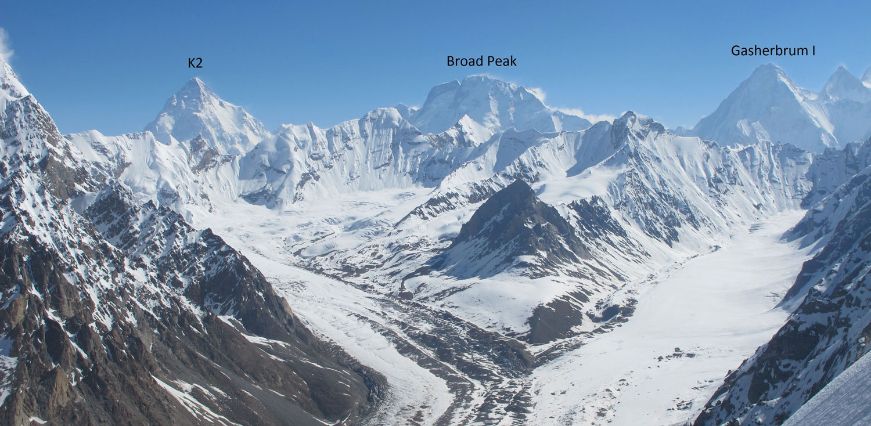
Broad Peak, the 12th highest mountain in the world at 8,047 meters, is located in the Karakoram Range in Northeastern Pakistan. The mountain is located along the western Baltoro glacier between K2 and Gasherbrum IV.

The first westerner who saw the peak was probably Lieutenant T.G. Montgomerie. He was surveying the mountains in the area and in 1856 he spotted some extraordinary peaks, which he gave temporary names. K for Karakoram + a number for the peak. K1, K2, K3 etc. Montgomerie later found out K1had a local name; Masherbrum. K2, still goes under that name, even if some have proposed to re-name it Qogori, a name used by some local people. K3, the third peak to be measured by Montgomerie didn’t have a local name.
The summit ridge of the peak is almost 2 km long and therefore British explorer W.M. Conway thought Broad Peak was a suitable name.

Conway noted: “a fine breadth of mountain splendour…a huge Breithorn, as it were, filing the space between K2 and the hidden Gasherbrum.” The name won general acceptance, but some zealots on a mission to get rid of all western names wanted a local name on the peak. They did not find any credible name candidates, so they did what they considered second best: they simply translated Broad Peak into Balti, the local Tibetan dialect. The name – P’alchan Kangri/Ri. It became a bit bastardized over the years and is nowadays spelled and pronounced Falchen Kangri, which is completely off the mark as there are no “f-sounds” in Balti.

One or two 8000m peaks?

A sometimes raging debate about Broad Peak having one of two “real summits” has been going on for a long time. Most people agree on the fact the central peak is not a separate summit, but the advocates in favor of counting it as one points at the snow on the col in between this summit and the main summit. If the snow are melting due to global warming, Broad Peak central would certainly qualify as the 15’th 8000m peak. Another issue connected to global warming is the fact that the snow on the true summit is melting and the fore summit may overtake it in height. This would be welcomed by climbers as the trickiest part of the whole climb would disappear.

First ascents of the main summits

Broad Peak has three separate summits: main summit 8,047 meters, central summit 8,016 meters, and north summit 7,550 meters.

The first ascent of the main summit was made in 1957 by an Austrian expedition consisting of only four climbing members. Using many of the fixed lines set up by the failed German expedition of 1954, all four summited without using oxygen. Hermann Buhl, Fritz Wintersteller, Kurt Diemberger and Marcus Schmuck didn’t have the help of any HAPs (high altitude porters) or guides and the climb was a remarkable success for alpine style climbing, as it occurred well before the time of small independent teams attempting the highest peaks on earth.
Clouds around Broad Peak early in the morning

Broad Peak Middle was climbed by five members of Polish expedition: Marek Kesicki, Bohdan Nowaczyk, Kazimierz Glazek, Janusz Kulis and Andrzej Sikorski. They summited on 28th of July 1975. Kesicki, Nowaczyk and Sikorski died during the descent.
The leader of this expedition was Janusz Ferenski.

The north summit was finally acquired in 1983 by an Italian expedition led by Renato Casarotto.

Climbing Broad Peak

From the first ascent in 1957 to August 2003, Broad Peak was climbed 255 times and had 18 deaths. The fatality rate is therefore about 7%, which could be compared with for example Everest which has a death rate of 9%. It is one of the safer 8000m peaks, but the risk of avalanches should never be disregarded.

Many teams today use the moderate climbing on Broad Peak to acclimatize for a rapid alpine style ascent of K2. The main route to the summit, via the west ridge, is moderately strenuous, but like other mountains in the Karakoram range, weather is often the determining factor.

Only 5 people have climbed twice and no-one more than that.

To the true summit or not?

Broad Peak is as Xixabangma and Cho Oyu a peak where a huge majority of “summiteers” don’t reach the true summit. A lot stop at the fore-summit and claim to have climbed Broad Peak. In 1994 Hans Kammerlander was sick of this and left a piece of red and purple rope, attached to a ski pole on the summit and asked other climbers what they had seen up there.

Later Ascents

1984 One astonishing ascent occurred in July of by the amazing Polish climber Krzysztof Wielicki. He left base camp at 4,850 meters at midnight, reaching camp1 at 4am, camp2 at 8am, the col at 2pm, and the main summit by 4pm. His ascent of 3,150 meters in less than 14 hours was an incredible achievement for its time. He completed the round trip in just over 22 hours, all solo. This solo ascent of an 8,000 meter peak in a day was not repeated until 1986.

1994 Even faster than Wielicki was Swede Göran Kropp when he soloed the peak in 18½h.

1982 Jerzy Kukuczka and Wojciech Kurtyka read their climbing permit for K2 carefully. it said: Acclimatization on lower peaks in the area allowed.
As Broad Peak is lower than K2, they came to the conclusion it may be allowed and went for the summit as a step in the acclimatization process. On the way up they met Messner, who asked them if they had summited. Kurtyka told messner: We were in the area. Messner smiled and said: Yes. Yes. Understood. He further promised not to tell anyone about the meeting. Messner kept quiet until he released his book “Three Times Eight”.

See the booklist for Kukuczka’s and Messner’s books about this incident and more interesting reading about their climbs of all the 14 8000’rs.

From Skardu to Broad Peak.
There are two routes to the peak from Skardu – via Askole or via Gondogoro Pass. The former is to recommend if you’re not acclimatized. Gondogoro Pass is a mighty 5600m, so most trekkers use this route for the way back.

To Askole.
A jeep ride takes 6-8h on partly miserable roads.
In Askole you can either camp out in the wild or use the one of the camping places, Facilities includes toilets, running water and a grassy, walled camping area.

The first camp site along the route is Jhula. It takes anywhere between 4 and 8 hours to reach Jhula from Askole and the trek is very straight forward. Most of the time you walk on good paths along a river. An early start is recommended as it gets very hot in this area. Two bridges where you have to pay a small fee have to be crossed. Jhula has shower cabins, running water, toilets and camp platforms.

Normally, there is not a problem to reach Paiju the second day. The trek is harder as you sometimes walk in sand along the rivers and there are some ups and downs en route. Paiju has the same facilities. The place can be very crowded in the high season and if you don’t like that, just continue for another 20 minutes to the first stream or to where the glacier start, where a very good place to camp is situated. Fresh water available here.

The next camping place is Urdukas, which has very good views of the Trango group. The camp site is situated on a hillside with good camp spots. Facilities is the same as Jhula and Paiju. If you want to go further or a part of the way to Urdukas, remember you’ll be camping on the actual glacier.

From here on the length of a normal day trip varies a lot depending on how the persons in the group feel. There are some camps along the way, but they are all very basic, consisting of shelters built of rocks. Most groups stop at Goro II, some stop an hour before this camp, Goro I and some go all the way to Concordia.

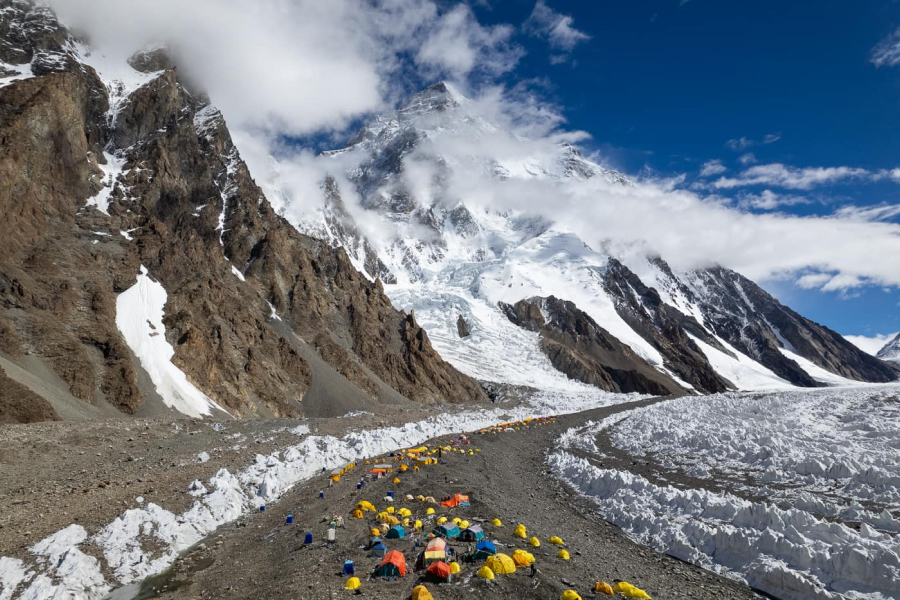
Concordia, which could be one of the most beautiful places on earth is sadly full of garbage and human waste. To the left you can see Broad Peak and K2. Ahead you Gasherbrum IV is looming and to your right is the impressive Mitre.

The rest of the way to Broad Peak BC is an easy 3-hour walk on upper Baltoro glacier.

Walking out via Gondogoro Pass

Gondogoro Pass (or La as it is in the local language) is sometimes stated to be the highest pass in the world and the altitude given on many maps are over 5900m. It’s not that high, but at 5600m it’s still a very impressive pass. Many teams choose to walk out this way because of the outstanding views from the pass summit. Masherbrum (7821m) is very close and to your NW you see the whole Gasherbrum group, Chogolisa (7665m), Baltoro Kangri (7800m) and a lot of other high beautiful peaks. To the north K2 and Broad Peak are visible. In the south the extraordinary Laila Peak can be seen.

From Concordia it’s a long day’s walk to Ali Camp. First you walk past Mitre Peak and head up the next valley/glacier on your right hand side. Watch out for rock falls when entering the valley and try to gain access to the icy part of the glacier as soon as possible. Better to walk up there then down in the scree. When approaching Ali Camp, watch out for crevasses.

For an acclimatized mountaineer, this is probably normal. It can be very windy on top of the pass, as it is a lot of elevation drop on the SW side. Don’t trust the ropes on this side either. It’s quite steep on this side (40-45 degrees). Stay up high on the right-hand side if no tracks. There are glaciers in the middle of the glacier further down. The path gets really good before the little camp site of Xhuspang/Shispang, where you also can get very basic meals.

The glacier gets more difficult to travel after the camp and when you have passed the first rocky part and entered the main valley, stay to the left all the time. Doing so makes you avoid all the large crevasses and the left hand side is also the side you leave the valley on. When at the bottom of the first valley, take a left and enter some very nice meadows with yaks. Excellent views of sharp peaks. Some tricky, slide sections have to be passed. The walk gets easier again when heading down the lower part of the Gondogoro glacier towards Shaishcho. In this little settlement you can eat and pitch your tent under nice-smelling wild roses.
From here it’s a very easy 2 to 3 hour walk to Hushe.
The Hushe – Skardu road is of awful condition for the first couple of hours. Lots of apricot orchards followed. From close to Khaplu the road is asphalt all the way into Skardu. Count on 5-8 hours from Hushe to Skardu.

Routes Overview

·  Standard Route – West Ridge
1957 – Austrian. Wintersteller, Diemberger, Buhl and Schmuck.

·  Carsolio Route – West Ridge to South Face
1994 – Mexican. Carsolio.

·  The Long Summit Ridge Traverse
1984 – Polish. Kukuczka and Kurtyka.

·  South West Face
2005 – Russian/Italian. Urubko

The false summit of Broad Peak

Permits for Broad Peak

You need a permit to climb the peak, which you can get hold via an expedition agent (www.jasminetours.com) The fees is :

Broad Peak: 2500 USD per person (2025) up to 15 members in one team.

.
An environmental (Central Karakoram National Park) fee of $200 also have to be taken into account.

When To Climb

June to September is the normal climbing season.

Broad Peak has also been attempted in the winter. The rocky summit (lower part of main summit) (8,016 meters) was climbed in the winter by Maciej Berbeka of Zakopane, Poland in 1988. Maciej mistook this summit for the main summit in poor weather. In 2003, a Spanish team attempted a winter ascent but were turned back by extreme wind and cold. Several camps were destroyed, but luckily no-one perished. Most of these winter ascent including successful Polish Winter summit was organize by Jasmine Tours.

[ ]


From $1800

One Tour Per Person

Name


Selected Value: 0
Pay Deposit of $170 Per Person Now
6 x $1,800 = $10,800

Translate »